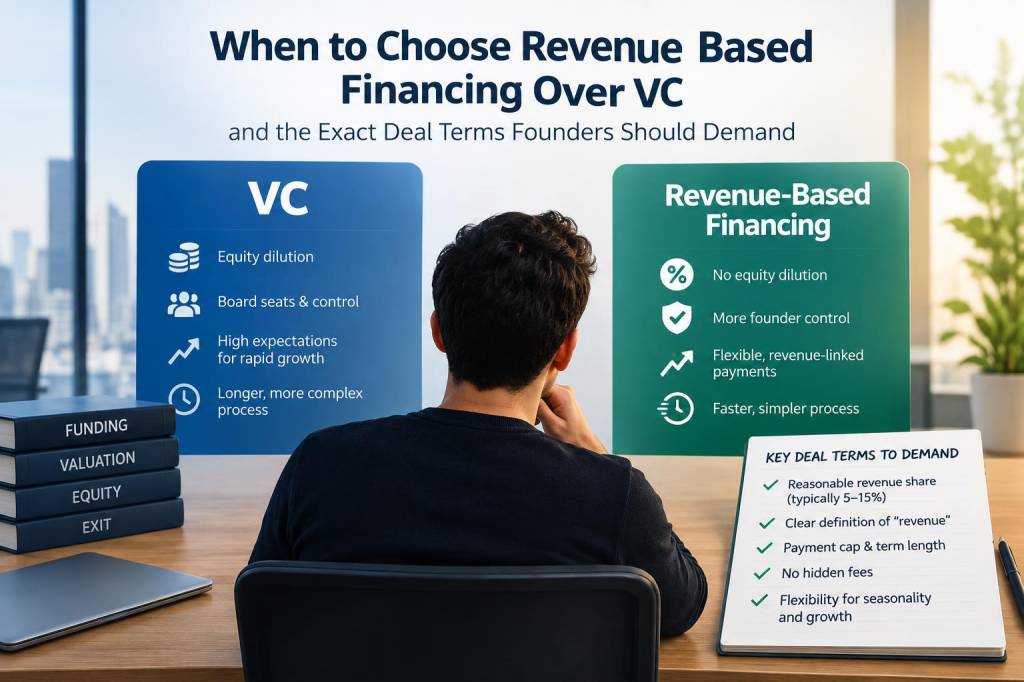
I get asked a lot by founders whether they should raise venture capital or pursue alternative funding. Lately one option comes up more and more in conversations with entrepreneurs: revenue-based financing (RBF). I’ve worked with startups at various stages and watched how different capital structures affect growth, control, and eventual outcomes. In this piece I’ll walk you through when RBF makes more sense than VC, the specific deal terms you should be negotiating as a founder, and the practical trade-offs you must accept.
What revenue-based financing actually is — and why founders like it
Revenue-based financing is a form of capital where an investor provides cash in exchange for a fixed percentage of a company’s ongoing gross revenue until a predetermined repayment cap is reached. Instead of giving up equity or paying a fixed interest rate, you commit a slice of top-line revenue. That structure is attractive because it aligns investor returns with your performance, preserves founder ownership, and avoids dilution.
In my experience, founders appreciate RBF for three core reasons:
- Minimal dilution: You keep the equity and control that venture capital would otherwise take.
- Payment flexes with revenue: When sales are soft, repayments fall; when sales spike, you pay more. That can be less punishing than a fixed loan payment.
- Speed and simplicity: RBF deals are often faster to close than VC rounds, and the paperwork can be cleaner—no prolonged board negotiations or deep-dive term sheet battles.
When to choose RBF over VC
I recommend RBF in the following scenarios:
- Predictable recurring revenue: If you run a SaaS company, subscription business, or other models with consistent monthly revenue, RBF works because repayments scale predictably.
- Moderate growth needs: When you need capital to accelerate growth by 2x–3x rather than to chase hyper-scale. RBF is ideal for profitable or near-profitable companies that want fuel, not a full-scale venture blitz.
- Desire to avoid dilution: If keeping equity and decision-making power matters more than access to large, strategic VC networks, RBF is attractive.
- Shorter runway requirements: When you want a bridge to profitability or a modest growth bump without the pressure of achieving VC-style exit milestones.
- Founders who want flexible covenants: If you’re wary of aggressive VC governance (board seats, protective provisions), RBF can offer fewer governance intrusions.
On the flip side, RBF is not for large, capital-intensive scaling where you need tens of millions to birth category dominance. If you’re building a market-defining AI platform, biotech, or require heavy CAPEX, venture capital’s scale, network, and follow-on capacity often win.
Key metrics investors look for — and what that means for you
RBF investors focus on cash flow and gross margin more than unit economics optimized for growth. Expect them to scrutinize:
- Monthly recurring revenue (MRR) and growth rate
- Gross margins (high margins mean more free cash to service the repayment)
- Customer churn and lifetime value (LTV) to customer acquisition cost (CAC) ratio
- Revenue concentration (diversified revenue reduces risk)
In practice, if your gross margins are below ~50% or your revenue is highly lumpy, RBF pricing will be worse or the deal may not be offered at all.
The exact deal terms founders should demand
When considering RBF, don’t accept the first offer. Here are specific terms I insist founders negotiate:
- Repayment cap (multiple): This is the total amount you repay expressed as a multiple of the principal (e.g., 1.5x–3x). Aim for the lowest multiple possible. For healthy SaaS with >60% gross margin, a reasonable range is 1.3x–1.8x. Avoid anything above 3x unless your growth profile is very strong.
- Revenue share percentage: The percent of top-line revenue paid each period. Balance between keeping payments manageable and keeping the investor incentivized. Typical ranges are 2%–10%. For early-stage SaaS with steady MRR, aim for 3%–6%.
- Minimum and maximum payment caps: Insist on a floor and a ceiling to avoid excessive short-term quarterly drain or indefinite tail payments. A floor protects the investor; a ceiling protects you from paying forever in growth years.
- Term length or time cap: A maximum time horizon (e.g., 36–60 months) after which remaining obligations are forgiven or renegotiated. Avoid open-ended deals that could hang your cash flow indefinitely.
- Revenue definition clarity: Precisely define what counts as revenue (gross vs. net, returns, refunds, upsells). Exclude pass-through items and one-off professional services if possible.
- Negative covenants and restrictions: Push back against onerous covenants (e.g., limits on hiring, customer discounts, M&A restrictions). Keep covenants narrow and time-limited.
- Prepayment flexibility: Require the right to prepay without heavy penalties. If you hit a big exit or debt refinancing, you should be able to clear the RBF cheaply.
- No equity kickers unless negotiated fairly: Some RBF deals include warrants or small equity stakes. If offered, cap the dilution and push for valuation caps you deem fair; if you want to avoid dilution, demand a no-warrant clause.
- Change of control protections: If you sell the company, ensure the investor’s payoff is limited to a fair prorated amount, not a punitive windfall.
- Reporting frequency and privacy: Limit reporting obligations to practical intervals (monthly or quarterly) and protect sensitive data. Investors often ask for detailed financials; narrow it to what’s necessary.
Sample term comparison (VC vs RBF)
| Feature | Venture Capital | Revenue-Based Financing |
|---|---|---|
| Equity dilution | High (board seats, protective provisions) | Low to none |
| Repayment | No regular repayment (exit-based) | Fixed % of revenue until cap |
| Investor involvement | High (strategy, governance) | Low to moderate |
| Ideal for | High-growth, capital-intensive scaling | Predictable revenue, moderate growth |
Practical negotiating tips
From my conversations with founders and investors, the most effective negotiators come prepared. Bring a 12–24 month revenue model, churn analysis, and scenario plans that demonstrate how different revenue-share percentages affect cash flow. Ask for multiple term sheets when possible so you can create leverage. And always model worst-case scenarios: what happens to burn and hiring if revenue drops 30% for three months?
Finally, don’t undervalue optionality. Some RBF providers offer convertible features, or staged advances tied to milestones. These can be helpful, but make sure they don't convert into punitive dilution if you later raise VC.
If you want, I can run through a sample term sheet with numbers based on your MRR and margins to show what a balanced RBF deal might look like for your business. Business News often publishes case studies and sample agreements, and I’m happy to walk you through them.