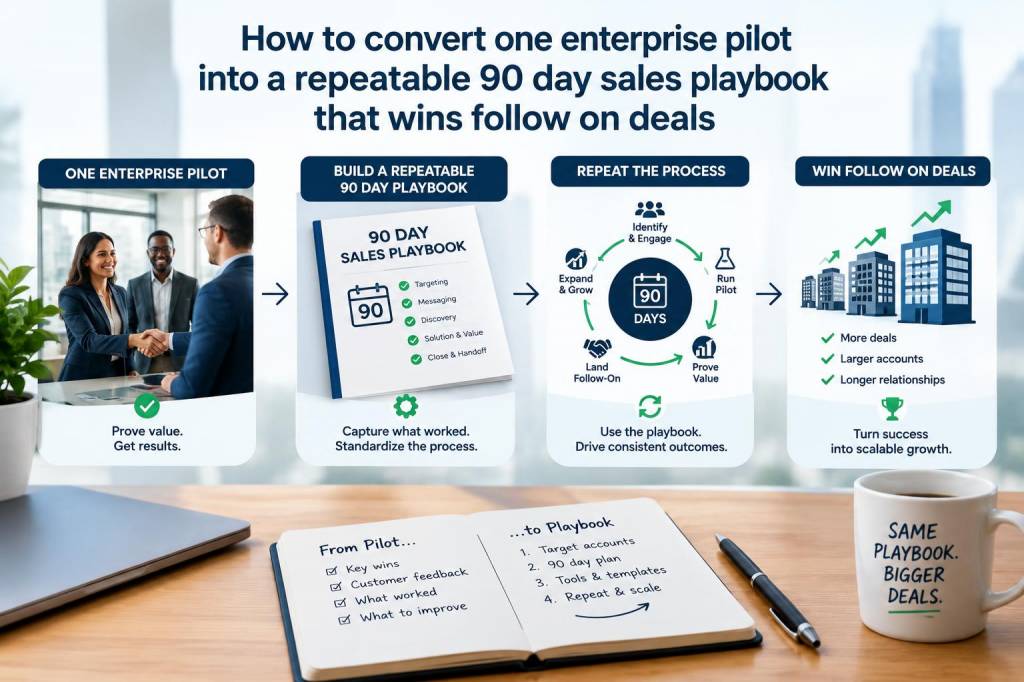
I remember the first time a pilot I led turned into a full-scale deployment — not because the product magically sold itself, but because we treated that pilot like a repeatable experiment and built a 90-day playbook around what actually moved the deal forward. If you want to turn one enterprise pilot into a predictable pipeline of follow-on deals, you need a process that captures value, proves ROI fast, and arms your sales team with repeatable tactics. Below I share the step-by-step approach I use to convert pilots into predictable wins, plus the templates and metrics you can adapt to your own business.
Start with the right mindset: a pilot is a proof, not a demo
Too many teams treat pilots as elongated demos. I treat them as mini-projects with finite scope, measurable outcomes, and clear decision gates. From day one I ask: what does “success” look like in 30, 60 and 90 days? Define those outcomes with the customer and make them the north star of the pilot.
Define measurable success criteria
Working with procurement, product, and the sponsor on the customer side, I co-create a success criteria document that includes:
Put these in writing and get sign-off. If the sponsor cannot commit to measurable outcomes, the pilot is unlikely to convert.
Map stakeholders and align incentives
I create a simple stakeholder map that captures the sponsor, technical champions, procurement, operations, and finance. For each stakeholder I list:
This helps us tailor communications and avoid nasty surprises when procurement surfaces hidden constraints late in the process.
Design the pilot to de-risk the purchase
Your pilot should remove the unknowns that block purchasing decisions. I design pilots that answer three core questions: does it work technically at scale, does it produce measurable business impact, and can my customer operate it?
Keep pilots short and focused — 30 to 60 days is often enough to prove value. Long pilots increase cost and reduce urgency.
Instrument everything: data is your conversion engine
Every pilot needs a dashboard. I work with the customer to agree on data sources, cadence, and a shared dashboard. The dashboard should include baseline metrics, pilot metrics, and a forecast of impact if rolled out.
When you can show an unambiguous delta in the customer’s KPIs, conversations shift from “maybe” to “how much and how fast.”
Build a 90-day sales playbook structure
Once a pilot succeeds, the playbook is what lets your sales team repeat that success. My 90-day playbook includes:
Store these assets in a central repository (e.g., Google Drive, a CRM playbook module, or a sales enablement tool like Highspot).
90-day example timeline
| Day Range | Focus | Key Deliverable |
|---|---|---|
| Day 0-14 | Capture pilot outcomes, finalize dashboard, executive alignment | Signed Success Criteria + Shared Dashboard |
| Day 15-30 | Proof of value communication: executive business review | 30-day Results Deck + Initial ROI Snapshot |
| Day 31-60 | Scale planning: scope, pricing, implementation plan | Draft SOW + Implementation Timeline |
| Day 61-90 | Commercial close and kickoff for rollout | Signed Contract + Rollout Kickoff |
Equip sales with tangible assets
Close deals faster by giving reps assets that answer procurement and executive needs. I include:
When procurement sees a clean SOW and security pack, negotiation shortens.
Use pricing and contracting to remove barriers
I’ve learned to make contracting a frictionless path: offer pilot-to-production credits, staged payment terms tied to milestones, and a clear upgrade path. Consider:
These levers reduce the time between pilot success and signed commitments.
Run executive business reviews — early and often
Don’t wait until the pilot is over to brief executives. I schedule short executive reviews at day 14, day 30, and day 60. Each review has a single ask: the next decision. Keep the agenda focused and the materials crisp.
Turn wins into repeatable messaging
After each converted pilot, capture the playbook lessons into a repeatable format. I update the battle cards with real quotes, the ROI model with actual numbers, and the objection list with the most effective rebuttals. Make sure marketing converts success stories into one-pagers and case studies that sales can use in future conversations.
Common pitfalls and how I avoid them
I’ve used this approach across enterprise software pilots for analytics platforms, security tools, and workflow automation systems. Whether the customer is using Snowflake, Microsoft Azure, or a bespoke data stack, the core principle is the same: make value measurable, make contracting simple, and give your sales team repeatable artifacts that shorten the path to a decision. If you treat each pilot as the first run of a standardized, data-driven playbook, you’ll stop celebrating one-offs and start building a predictable engine for follow-on deals.