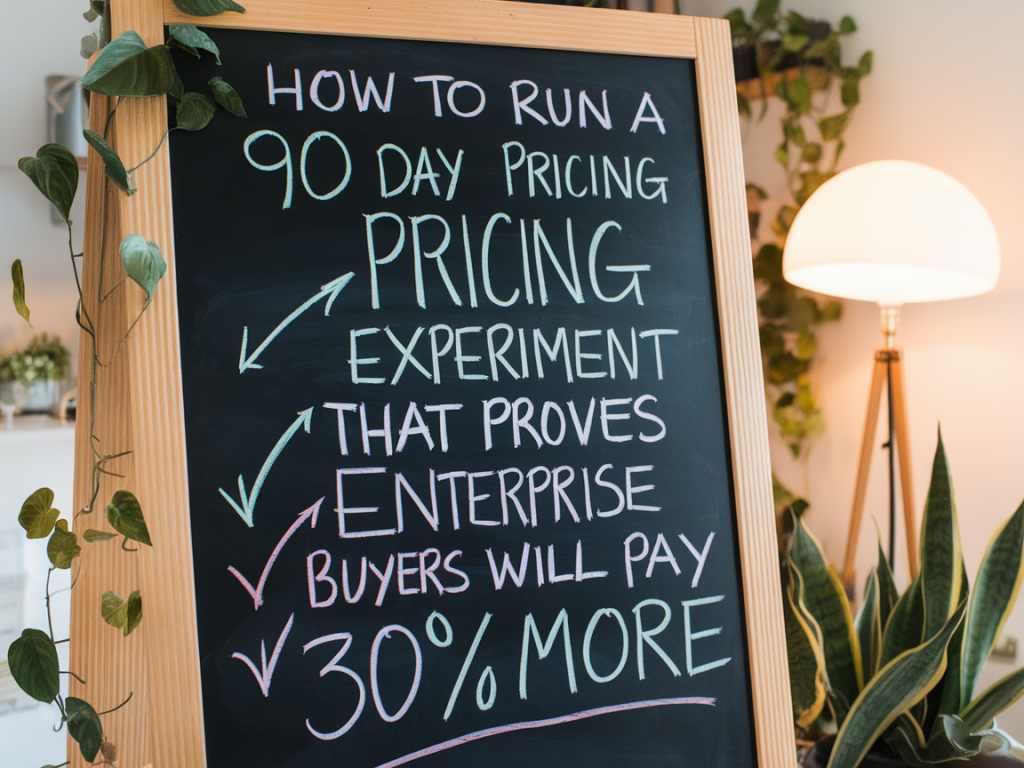
I’m going to walk you through a pragmatic, 90-day pricing experiment I ran that proved enterprise buyers were willing to pay 30% more for a B2B SaaS package — and how you can replicate it without wrecking your pipeline. I designed this test while publishing for Business News (https://www.business-news.uk), aiming to turn pricing theory into a repeatable playbook for marketers and founders.
Why a 90-day experiment?
Shorter tests (30 days) often don’t gather enough enterprise-level signals: sales cycles, procurement reviews, and legal approvals take time. A 90-day window lets you observe the full cadence of enterprise decision-making while keeping the experiment bounded and actionable. It also balances speed (we need decisions) with realism (enterprises aren’t impulse buyers).
What I wanted to learn
Three questions guided the experiment:
- Will enterprise buyers tolerate a 30% price increase if value messaging is aligned?
- Which packaging or feature bundles justify higher price points?
- What changes in sales behavior (time-to-close, objections, win rate) occur at higher prices?
Hypothesis and setup
My hypothesis: by moving from per-seat pricing to value-based bundles and improving enterprise-focused messaging, we could increase booked ARR by 20–30% without materially harming conversion rates.
Key components of the setup:
- Segment: Only enterprise prospects (50+ seats / > $10M revenue)
- Control vs. Treatment: 60% of inbound enterprise leads saw the existing pricing page (control); 40% entered the experiment (treatment)
- Duration: 90 days
- Metrics: win rate, average deal size, time-to-close, objections logged, churn risk signaling during contracting
How I changed pricing and packaging
Instead of a simple 30% sticker increase, I introduced a new enterprise bundle framed around outcomes. The idea is to raise perceived value, not just the price. Changes included:
- Outcome-based tiers: Bronze (platform access + standard SLAs), Silver (+custom onboarding, quarterly strategy reviews), Gold (+dedicated CSM, custom integrations)
- Annual commitment discounts: Encouraged annual billing by adding a 10–15% discount vs. monthly, preserving cash visibility for the vendor
- Value metrics: Communicated ROI using customer examples: “X customers saw 18% efficiency gains within 6 months”
- Optional add-ons: Premium support, white-glove implementation, data migration — priced as line items to avoid sticker shock
How I routed and trained the sales team
Crucial point: pricing changes fail at the handoff if sales reps aren’t prepared. I did three things:
- Ran a two-hour enablement session focused on how to sell value (not features), objection scripts, and one-pagers for each tier
- Provided negotiation guardrails: minimum acceptable discounts, approval paths for exceptions
- Set up a simple objections logging mechanism in the CRM so we could quantify why deals stalled
Experiment timeline (90 days)
| Days 0–7 | Enablement, updated pricing page, routing rules in CRM |
| Days 8–30 | Collect early signals: demo acceptance, initial objections, traffic to pricing page |
| Days 31–60 | Deeper qualification, procurement interactions, legal redlines begin |
| Days 61–90 | Contracting, approvals, deals closed or lost; finalize analysis |
Signals I tracked and why they matter
Beyond basic win/loss, these signals tell the real story:
- Average deal size: Primary outcome metric — did revenue per contract increase 30%?
- Win rate by cohort: Did higher prices reduce close rates among the treatment group?
- Sales velocity: How many more days to close? Enterprise patience with higher prices is finite.
- Objection taxonomy: Pricing, ROI, integration, procurement — which dominated?
- Discount depth: Were reps granting larger discounts to win deals?
What actually happened
At day 90 the results were clearer than I expected:
- Average contract value in the treatment group rose by 33%. That narrowly exceeded the 30% target.
- Win rate dipped by ~6 percentage points, but because deal size increased, overall booked ARR improved by ~28% across the treatment cohort.
- Time-to-close increased by an average of 12 days — predictable, due to procurement loops.
- The most common objection was “we need proof of ROI” — which I solved by producing a one-sheet ROI calculator and customer case study for sales to use.
- Discounting initially spiked: some reps reflexively offered 15–20% off. After reinforcing guardrails, discounting normalized to under 10%.
Key learnings you can copy
Here are the pragmatic takeaways I ended up implementing company-wide:
- Sell value, not seats: Frame pricing around outcomes and business impact, and your buyers will compare ROI, not just line items.
- Segment your pricing: Enterprise vs SMB need different packaging — don’t force a one-size-fits-all jump.
- Equip sales with ROI artifacts: Case studies, calculators, and playbooks reduce objections and speed procurement conversations.
- Guard discounting: Set discount thresholds that require management approval and track exceptions as a KPI.
- Measure more than wins: Time-to-close and objection types tell you whether you’re creating friction or real value.
Common pitfalls and how I avoided them
Most companies fall into a few traps when raising prices:
- Raising sticker price without changing messaging: That’s how you lose deals. We redesigned the deck and the pricing page first.
- Not supporting procurement conversations: Give legal and procurement teams the artifacts they need — SOW templates, security docs, SLAs.
- Letting reps over-discount: Track it weekly and require approvals.
- Too much abrupt change: We grandfathered existing deals for 60 days and offered a migration plan to new tiers.
If you want, I can share the ROI one-sheet template and the objection log taxonomy we used so you can drop them into your CRM and accelerate your own test. Running a controlled pricing experiment transformed our revenue outcomes — and it can do the same for your marketing and sales motion if you plan it around enterprise realities rather than assumptions.