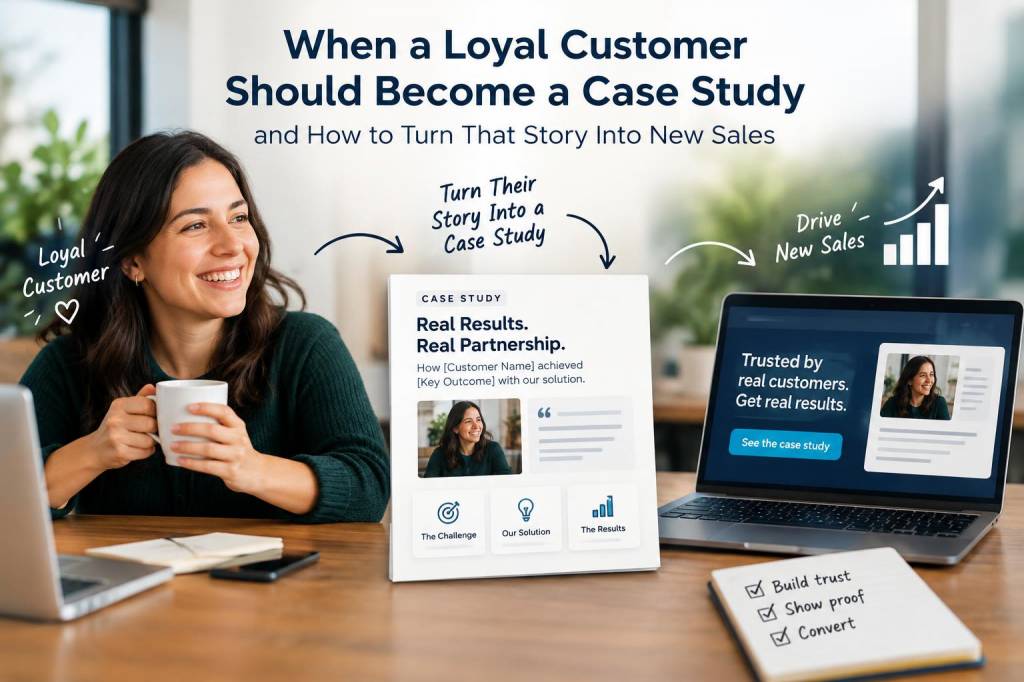
I have learned that a loyal customer can become far more than a happy buyer. When handled with care, that person can become a case study that proves your value in a way no polished slogan ever could. I do not mean using someone as a marketing prop. I mean turning a real, lived success story into a credible piece of evidence that helps future customers see themselves in your work.
In my experience, this works especially well in marketing because people rarely buy only from logic. They buy from trust, recognition, and belief. A case study gives them all three. It shows a real problem, a real process, and a real result. When a loyal customer has already experienced strong value and is willing to speak openly about it, I see an opportunity to create content that feels both human and persuasive.
When a customer is ready for a case study
Not every loyal customer should become a case study. I wait for signals that the relationship is strong enough and the outcome is meaningful enough to matter to others. The strongest candidates usually have a few things in common. They have used my product or service long enough to see a clear transformation. They can explain their journey in practical terms. They are proud of the result and willing to share it publicly.
I also look for emotional clarity. If a customer says something like, “I was skeptical at first, but this solved a real problem,” I pay attention. That kind of language is powerful because it reflects the mindset of a future buyer. A case study is most useful when it captures hesitation, decision-making, action, and outcome. If the story is too smooth or too promotional, it loses credibility.
I usually know a story is ready when a customer has done one of the following:
- Achieved measurable growth after using my solution
- Saved time, money, or internal effort in a visible way
- Overcame a painful problem that others in the market also face
- Shared unsolicited praise that feels specific rather than generic
- Asked for a deeper partnership or extended engagement because results were strong
Why loyal customers make stronger stories than strangers
A loyal customer already gives me something that cold outreach never does: context. They have a history with my brand. They know the strengths and weaknesses of what I offer. They can speak with more nuance than a first-time user. That makes their story more believable.
I have also found that loyalty often creates honesty. A customer who stays is usually not pretending. They have tested the experience in real conditions. They have seen the service from different angles. They may even offer a balanced view, which is exactly what makes the case study trustworthy. A realistic story often sells better than a perfect one.
There is another reason loyal customers matter. Their story can reveal patterns. If one repeat client explains that my onboarding made implementation easier, that is not just a compliment. It is a signal that I should emphasize onboarding in future sales conversations. If several loyal customers mention speed, clarity, or support, I know exactly which benefits deserve more visibility.
What I ask before turning a story into marketing content
I never treat a case study like a one-way extraction. I ask permission, and I make the purpose clear. I explain where the content may appear, whether on my website, in email campaigns, in sales decks, or on social media. I also ask what level of detail the customer is comfortable sharing.
That conversation matters because trust is fragile. If I want someone to advocate for my brand, I need to protect their reputation, their time, and their boundaries. Sometimes I use a full company name. Sometimes I anonymize sensitive details. Sometimes I agree to review quotes before publication. The goal is not to control the story. The goal is to make participation feel respectful and safe.
I usually ask questions like these:
- What problem were you trying to solve before working with us?
- Why did you choose us instead of another option?
- What changed after implementation?
- Which result mattered most to your team?
- What would you tell someone who is still undecided?
These questions work because they move from pain to decision to result. That sequence mirrors the buyer journey. It also helps me collect usable language that sounds natural in a sales context.
How I shape the story so it sells without sounding forced
A case study should not read like an advertisement wearing a disguise. I try to write it like a narrative with proof. I start with a clear challenge, because that gives the reader a reason to care. Then I explain what action was taken, what support was provided, and what changed as a result. I always prefer concrete details over vague praise.
For example, “Our client was frustrated with slow lead response times” is more effective than “Our client needed help.” “Revenue increased by 28 percent over six months” is stronger than “Things improved a lot.” Specificity makes the content usable for sales teams and more convincing for readers.
I also avoid making my company the hero of every sentence. The customer should remain central. My role is to facilitate change, not to dominate the narrative. When the customer is the main character, the story feels authentic. That authenticity is what makes new sales possible.
I like to organize the story around four parts:
- Context: who the customer is and what situation they faced
- Challenge: what was broken, slow, costly, or confusing
- Action: what I delivered, adjusted, or improved
- Result: what measurable or visible outcome followed
How I turn one story into multiple sales assets
One strong customer story can fuel many channels. I do not stop at publishing a single blog article. I break it into reusable pieces that support different stages of the buyer journey. A long-form case study can become an email, a pitch slide, a social post, a short quote graphic, a webinar example, or a sales objection answer.
That repurposing matters because different buyers need different kinds of proof. Some want a detailed story. Others want a quick signal. Some are comparing vendors. Others are already close to buying but need reassurance. The same story can speak to all of them if I package it correctly.
Here is a simple structure I often use when turning one case study into new sales opportunities:
| Asset | Purpose | Sales use |
| Website case study | Full proof and detail | Supports high-intent visitors |
| Email sequence | Builds trust over time | Nurtures prospects with evidence |
| Sales deck slide | Fast credibility | Helps close live conversations |
| Short quote | Quick social proof | Works on landing pages and ads |
| Social post | Reach and visibility | Introduces the story to new audiences |
Why timing matters when I share the story
I have noticed that timing can make a huge difference. A case study works best when it appears at the moment a prospect is asking, “Will this work for someone like me?” If I wait too long, I miss the decision window. If I share it too early, the audience may not care yet.
That is why I align stories with buyer intent. When someone downloads a pricing page, attends a demo, or replies with objections, I know they are looking for evidence. That is when a relevant customer story can move the conversation forward. A case study is not just content. It is timing plus proof.
I also use case studies after a customer has become genuinely successful, not just immediately after purchase. Early enthusiasm can be helpful, but real outcomes create stronger marketing value. A loyal customer who has lived with the solution long enough can speak with authority. That authority is what gives the story weight.
What I watch for so the story does not damage trust
I am careful not to overstate results. If I exaggerate, I risk losing both the customer and the audience. Modern buyers are sharp. They can feel when a story has been polished into something unrecognizable. I prefer an honest story with a modest result over a dramatic claim that cannot be defended.
I also avoid making every case study sound identical. If every customer story says the same thing, readers will stop believing them. Variety matters. One story may highlight speed. Another may emphasize quality. Another may show ease of use or team alignment. Different outcomes attract different buyers.
Another risk is using only happy customers while ignoring complexity. A balanced story often feels stronger because it acknowledges a challenge before showing progress. I have found that when I include friction, the final result feels earned.
When I review a draft, I ask myself whether a skeptical buyer would believe it. If the answer is no, I keep refining. I want the story to feel useful, not decorative.
What loyal customers gain from being featured
There is also value for the customer. Many people appreciate being recognized for good results. A well-crafted case study can strengthen their own brand, showcase their team, and give them something useful to share internally. In some cases, it even helps them justify continued investment in my solution.
I have found that the relationship often becomes stronger after publication. The customer feels seen. I gain a clearer understanding of what mattered most to them. Future conversations become easier because we now share a public story with a shared outcome. That kind of mutual benefit is one reason I keep investing time in case studies rather than treating them as a side task.
When I do this well, I am not just creating content. I am building a library of proof that speaks for my business when I am not in the room. And when that proof comes from a loyal customer, it carries a kind of quiet authority that no paid message can fully imitate.