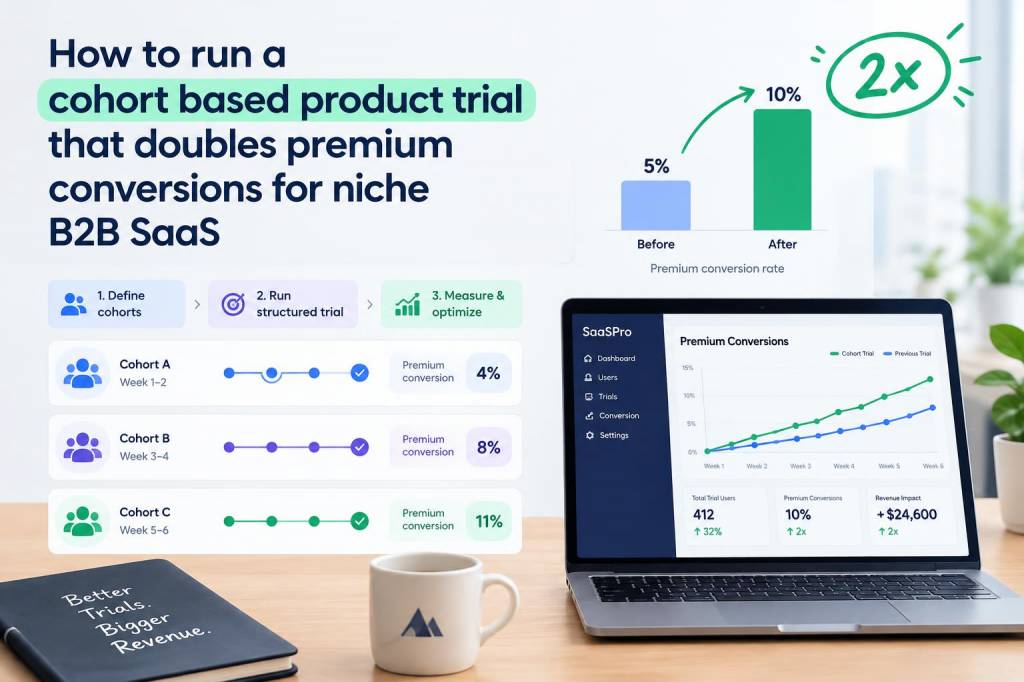
I’m going to walk you through a playbook I used to run a cohort-based product trial that doubled premium conversions for a niche B2B SaaS. This isn’t theory — it’s a tested approach combining product-led growth, instructor-led onboarding, and behavioral design. If you’re selling a specialized tool to tight-knit industries (think logistics analytics, legal ops platforms, or vertical HR software), this method will help you turn curious trials into confident, paying teams.
Why cohort-based trials work for niche B2B SaaS
In niche B2B markets, buying decisions are social and team-based. One power user rarely convinces finance or operations alone. A cohort-based trial creates shared momentum: teams learn together, discover value together, and surface cross-functional use cases that single-user trials miss. I found this increases perceived product value and shortens the time to a “team-wide” yes.
Put simply, cohorts transform solitary exploration into a guided, communal experience. People are more likely to adopt behavior when others on their team do it alongside them, and when the onboarding is tailored to real job outcomes.
How I structured the cohort-based trial
I use four core elements in every cohort: targeted recruitment, a compact curriculum, live facilitation, and outcome-based activation. Here’s how each piece fits together.
Targeted recruitment: Invite entire teams or cross-functional pairs (e.g., a product manager + an analyst). I focused on companies with a specific profile: 50–250 employees, operating in the niche vertical, and with an identified workflow problem our tool solved.Compact curriculum: A 2-week roadmap with 3 live sessions and specific “missions” to complete between sessions.Live facilitation: A product expert (often a solutions engineer) runs the cohort, answers questions, and highlights best practices.Outcome-based activation: Every task is tied to a measurable outcome (e.g., “create a dashboard that reduces report time by 40%”).Week-by-week playbook
Here’s the actual timeline I ran for a successful cohort that doubled premium conversions. I adapted it slightly depending on customer complexity, but the structure stayed the same.
Pre-trial (day -7 to 0): Screening call to confirm fit, send pre-work (survey + dataset upload), and schedule cohort sessions. I made sure expectations were crystal clear — by the time the cohort started, participants already had a dataset loaded.Week 1 — Session 1 (Kickoff, 60–75 minutes): Quick product tour tailored to the vertical, shared success stories from similar customers (social proof), and the first mission: build a baseline workflow or report. I used breakout rooms so teams could work on their instance with a facilitator for hands-on help.Mid-week touchpoint (30 minutes): Office hours for troubleshooting and to showcase advanced tips if a team finished early.Week 2 — Session 2 (Deep dive, 60 minutes): Focus on automation and collaboration features that multiply value across users. Teams presented their baseline and received feedback. I also introduced ROI calculators that translated usage into expected time or cost savings.Week 2 — Session 3 (Business review + next steps, 45–60 minutes): We co-created a rollout plan with the team, defined success metrics, and discussed pricing scenarios. I invited a customer success rep to outline support and migration paths.Post-trial (day +3 to +14): Personalized follow-up with a “value recap” — a one-page dashboard showing achieved metrics, recommended plan, and an incentive to convert (e.g., discounted onboarding or a pilot-to-enterprise credit).How I measured success
It’s critical to track both behavioral and commercial metrics. Here are the KPIs I monitored and why they matter:
Engagement metrics: cohort attendance rate, mission completion rate, feature activations per user.Value metrics: time saved per workflow, error reduction, reports generated — numbers you can show to a CFO.Commercial metrics: trial-to-paid conversion, expansion rate in the first 90 days, average contract value (ACV).Below is a simple example table I used to track cohorts. It made it easy to see which cohorts produced the best outcomes and why.
| Metric | Cohort A (Retail Ops) | Cohort B (Legal Ops) |
| Companies enrolled | 12 | 8 |
| Avg. attendance | 85% | 92% |
| Mission completion | 76% | 88% |
| Trial-to-paid | 18% | 40% |
| Avg. ACV increase | +12% | +48% |
Key tactics that doubled premium conversions
From dozens of runs, these tactics consistently produced outsized results:
Recruit whole decision groups: instead of inviting a lone power user, bring the person who signs checks and the people who will use it daily. That alignment speeds approvals.Make ROI tangible: convert feature usage into dollar or time savings during the sessions. I used simple calculators that projected outcomes for each company’s dataset — nothing impresses a finance team more than a 6-month payback estimate.Use micro-commitments: short missions create small wins and build momentum. Each completed mission increased the likelihood participants would commit to a paid plan.Leverage expert facilitation: a skilled facilitator prevents confusion, shows hidden value, and models best practices. Investing in one product expert per 8–12 companies paid off every time.Offer conversion incentives tied to outcomes: provide discounts or onboarding credits contingent on achieving predefined success metrics during the trial. That made the “premium” plan feel like an investment rather than a cost.Common challenges—and how I handled them
No run is perfect. Here are problems that cropped up and practical fixes I applied.
Low attendance: Reinforce commitments with calendar invites, reminders, and a short intro video. Make the first session time-limited and high-value to encourage attendance.Dataset readiness issues: Provide sample data and a concierge dataset onboarding option for teams with sensitive systems. If needed, we used anonymized templates to get them started faster.Focus on features, not outcomes: Push back gently by redirecting conversations to business problems. If a team obsessed over a feature, I asked: “What business problem will that solve this quarter?”Sales handoff friction: Create joint sessions with sales and success early in the trial. Sales must be part of the cohort narrative so the handoff doesn’t feel transactional.Examples of tools and formats that helped
I mixed synchronous and asynchronous content using tools that minimized friction:
Zoom or Hopin: for live cohort sessions with breakout rooms.Notion or Miro: to host the curriculum, missions, and shared ROI worksheets.Intercom or Slack channels: for cohort-specific support and quick wins sharing.Calendly + HubSpot: to handle scheduling and track funnel progress.For one cohort we integrated a Loom library of short (2–4 minute) demos for each mission. Those clips became reference materials that teams revisited long after the cohort ended, increasing long-term retention.
If you run a niche B2B SaaS, designing trials as a collaborative learning experience is one of the highest-leverage moves you can make. It shifts the perception of your product from “a tool” to “a team capability,” and that change in perception is what unlocks bigger deals and faster conversions.