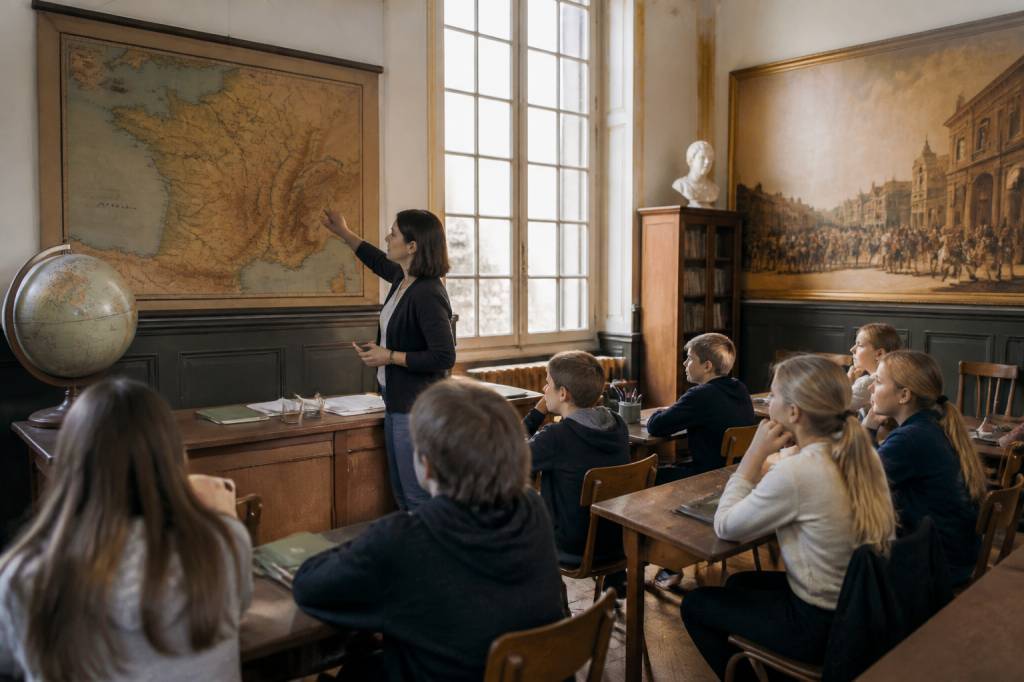
French schools have a distinct way of teaching history and culture, shaped by the country’s strong national identity, public education traditions, and commitment to civic values. For many learners, history classes in France are not only about memorizing dates and events. They are also about understanding how the nation was built, how ideas evolved, and why cultural heritage matters in everyday life. From primary school to the final years of secondary education, students are encouraged to see history as a living subject connected to literature, art, geography, philosophy, and citizenship.
This approach makes French education especially interesting to parents, students, and educators around the world. It combines a structured curriculum with a deep respect for intellectual debate and historical analysis. Rather than treating culture as an optional topic, French schools integrate it into the heart of learning. Students are exposed to a wide range of topics, from ancient civilizations and medieval France to the Enlightenment, the French Revolution, colonial history, and contemporary European issues.
The place of history in the French curriculum
History occupies an important role in the French school system because it helps students understand the development of the French Republic and its values. In many schools, the subject is taught alongside geography and civics, creating a broad framework for understanding society. This combination allows students to connect historical events with territory, institutions, and public life.
In elementary school, children are introduced to simple historical milestones and major figures. The goal is to build curiosity and a sense of continuity. As they move into middle school and high school, the lessons become more complex. Students study chronology, historical sources, causes and consequences, and different interpretations of events. They learn to ask questions such as why revolutions happen, how societies transform, and how collective memory is shaped.
French schools often emphasize a chronological structure. This means students usually move through history in sequence, starting with ancient civilizations and progressing toward the modern era. This method gives learners a clear framework and helps them understand long-term change. It also allows teachers to revisit themes such as power, religion, war, identity, and social justice across different periods.
How teachers present historical knowledge
Teachers in France generally aim to combine factual knowledge with critical thinking. Students are expected not only to remember dates and names, but also to analyze documents, compare viewpoints, and explain historical processes. A lesson might include a textbook chapter, a map, a primary source, a classroom discussion, and a written exercise based on the material.
French pedagogy often relies on document analysis. Students may examine letters, paintings, newspaper articles, speeches, photographs, or legal texts. This method teaches them how to interpret evidence and understand the perspective of the time. It also encourages them to distinguish between fact, opinion, and propaganda. By working directly with historical documents, students develop a more active relationship with the subject.
Essays and structured writing are also a major part of the system. French schools value the ability to organize ideas clearly, build an argument, and support it with examples. In history classes, this helps students move beyond passive learning. They learn to write introductions, develop a line of reasoning, and present a coherent analysis. This academic discipline is considered essential for success in later studies.
The role of culture in everyday school life
Culture in French schools is not limited to a single subject. It appears in literature, art, music, philosophy, language studies, and even extracurricular activities. Students often encounter French cultural heritage through readings from classic authors, study of paintings and monuments, and discussions about national traditions and public institutions.
Schools may organize visits to museums, historical sites, theaters, and memorials. These outings are not simply recreational. They are part of the educational process and help students experience culture in a concrete way. A visit to a museum can reinforce a lesson on the Renaissance, while a trip to a memorial can deepen understanding of war, remembrance, and civic duty.
Cultural education also includes learning about regional diversity. France is a country with many local traditions, accents, cuisines, and historical identities. Teachers may introduce students to the cultural richness of Brittany, Provence, Alsace, Corsica, and overseas territories. This broad perspective helps students appreciate the country as both a unified republic and a mosaic of local histories.
What makes a french school approach different
One of the defining features of a french school is its emphasis on intellectual rigor and the transmission of shared cultural knowledge. The curriculum is often centrally organized, which means students across the country study many of the same historical themes and cultural references. This creates a common foundation and supports a sense of collective identity.
At the same time, teachers are encouraged to foster debate and interpretation. Students are not expected to simply accept a single narrative. Instead, they are invited to explore different angles, especially when dealing with sensitive topics such as colonialism, world wars, or the development of democracy. This balance between structure and discussion is one reason French education is often admired internationally.
Another important aspect is the relationship between history and citizenship. French schools see history as a way to prepare students for democratic life. By studying the Revolution, the Republic, secularism, human rights, and resistance movements, students gain a better understanding of the values that support public life in France. Culture and history are therefore treated as tools for forming informed, responsible citizens.
Major historical themes students learn
The French curriculum usually covers a wide range of historical periods and subjects. Some of the most common themes include:
- Ancient civilizations and the heritage of Greece and Rome
- The Middle Ages, feudalism, and the rise of kingdoms
- The Renaissance and the growth of humanist thought
- The Enlightenment and the spread of new political ideas
- The French Revolution and the birth of modern republican values
- Industrialization, urban growth, and social change
- World War I and World War II
- The Holocaust, resistance, and memory
- Decolonization and the transformation of global power
- European integration and contemporary challenges
These themes are chosen not only for their importance to French identity, but also because they help students understand broader global processes. The curriculum encourages connections between France and the wider world, showing that national history is always part of a larger international story.
Literature, art, and philosophy as cultural gateways
French schools make strong connections between history and other intellectual disciplines. Literature classes often include works from authors such as Molière, Victor Hugo, Voltaire, Balzac, Camus, and other major figures. These texts help students understand the ideas, values, and tensions of different historical eras. A novel or play can become a window into the society that produced it.
Art history also plays an important role. Students may study masterpieces from the Louvre, Impressionist painting, architecture, and public monuments. These lessons develop visual literacy and give students tools to interpret cultural symbols. They also reinforce the idea that national culture is built through artistic achievement as well as political events.
Philosophy, especially in the final years of secondary school, strengthens this cultural education further. French students are encouraged to reflect on concepts such as freedom, justice, truth, memory, and identity. These ideas are closely linked to history, since they help students think about how societies evolve and how citizens understand their place in the world.
Secularism and republican values in the classroom
French schools are strongly influenced by the principle of laïcité, or secularism. This principle shapes not only religious education, but also the way history and culture are discussed. Teachers aim to present knowledge in a neutral and inclusive environment, where the focus remains on shared civic values and academic inquiry.
Secularism does not mean removing culture from school. On the contrary, it allows schools to teach about religion, beliefs, and traditions in a historical and comparative way. Students may study the role of Christianity in medieval Europe, the influence of the Enlightenment on modern thought, or the evolution of religious diversity in France. The approach is analytical rather than devotional.
Republican values such as liberty, equality, and fraternity are also central to classroom life. History lessons often return to the moments when these ideals emerged, were challenged, or were defended. Students learn how these values became part of the French political tradition and why they continue to matter today.
Assessment and student expectations
Assessment in French schools tends to be demanding, especially in history and culture-related subjects. Students are usually evaluated on their ability to understand texts, construct arguments, and express ideas in a clear, structured way. Exams may include document analysis, essay writing, or short-answer questions that require precise knowledge and reasoning.
This system reflects the broader goals of French education. Teachers want students to develop discipline, clarity, and intellectual independence. Memorization is important, but it is not enough on its own. Learners must also be able to explain, compare, and interpret. The goal is to create students who can think critically while respecting academic standards.
Because of these expectations, many students receive strong training in writing and oral expression. Class presentations, debates, and discussions are used to strengthen confidence and communication skills. Over time, this helps students become more comfortable with complex subjects and more capable of analyzing culture in a thoughtful way.
Why this approach matters beyond France
The way French schools teach history and culture offers useful lessons for education systems elsewhere. It shows the value of combining national heritage with critical thinking, and of treating culture as an essential part of learning rather than an optional extra. Students benefit from a curriculum that helps them understand both their own society and the wider world.
This model also encourages deeper engagement with the past. When history is taught as a series of interconnected stories, rather than isolated facts, students are more likely to see its relevance. They begin to understand that political choices, social movements, artistic developments, and philosophical ideas all shape the world they live in.
For families looking into international education, French schooling often appears attractive because it blends academic rigor with cultural depth. It values language, argument, memory, and civic awareness. It also gives students repeated opportunities to encounter major works of literature, art, and historical thought.
A living tradition of learning
French schools continue to adapt, but their approach to history and culture remains rooted in long-standing educational principles. They aim to transmit knowledge, encourage reasoning, and build a shared civic culture. That combination gives students more than information. It gives them a sense of context, identity, and responsibility.
By exploring the past through documents, literature, art, and discussion, students learn how societies change and why memory matters. By studying culture in class, they discover that heritage is not static. It evolves through language, creativity, debate, and public life. In that sense, French schools do more than teach history. They help students understand how a nation tells its story and how that story continues to be written every day.